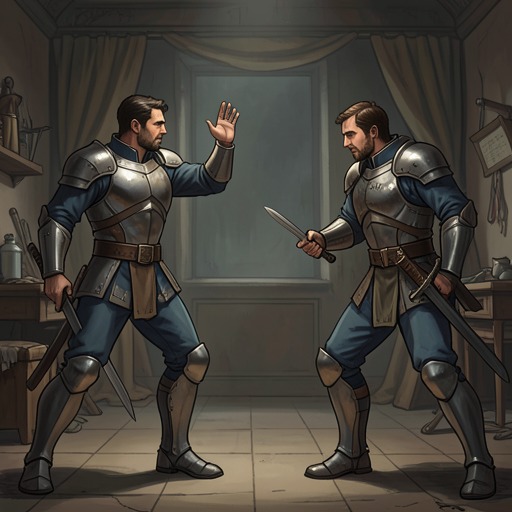
Disrupt the enemy's balance
The Book of Five RingsTo Cause Loss of Balance is a rule for making an opponent’s spirit falter and turning that disruption into an advantage. Miyamoto Musashi identifies danger, hardship, and surprise as causes of lost balance, then gives the rule a practical sequence: attack where the enemy does not expect it, seize the moment of indecision, and press the advantage before the opponent can recover. It applies to both large-scale strategy and single combat, linking the disruption of an enemy’s composure to the larger discipline of timing and initiative.
Causes and Opening
Musashi names three sources of imbalance: danger, hardship, and surprise. These are not presented as interchangeable labels for a single sensation; together they describe different pressures that can unsettle an opponent. The tactical purpose is to recognize that instability and use it, rather than to treat the opponent’s loss of composure as an end in itself.
Surprise is especially important because it can interrupt the enemy’s decision before a response has taken shape. Musashi’s instructions make the opening temporal as well as psychological: the strategist must act while the enemy’s spirit remains undecided. Delay would allow the opponent to recover form and restore the balance the attack has disturbed.
Application in Large-Scale Strategy
In large-scale strategy, the prescribed attack comes without warning and at a point where the enemy is not expecting it. The suddenness is meant to unsettle the opposing force; while its spirit remains unresolved, the strategist follows up the advantage and, having taken the lead, defeats it. The sequence is therefore not simply an initial strike followed by more force. Its decisive interval is the enemy’s hesitation, which the attacker must exploit before it passes.
This rule also depends on observing the enemy’s condition. Musashi’s account of knowing the times asks the strategist to judge whether the enemy’s disposition is flourishing or waning, to read the spirit of the enemy’s men, and to choose a position of advantage. Loss of balance belongs to this wider practice of assessment: the strategist watches for a moment when the opposing force can be thrown off, then moves in accordance with that opening.
Application in Single Combat
In a duel, Musashi describes a deliberate contrast between apparent slowness and sudden force. The fighter first makes a show of being slow, then attacks strongly. The change in pace is intended to produce a fluctuation in the opponent’s spirit; once that fluctuation appears, the fighter must leave no space for the enemy to breathe and recover form. The opening is brief, and success depends on grasping it rather than merely initiating an unexpected attack.
The method places composure and tempo in a reciprocal contest. An apparent lack of urgency can shape the enemy’s expectations; the abrupt attack then unsettles them. The fighter’s task is to maintain enough control to recognize the resulting instability and continue pressing until it becomes a victory, rather than allowing the opponent time to re-form.
Place in the System of Strategy
The rule belongs beside Musashi’s three methods of forestalling the enemy: attacking first, responding as the enemy attacks, and meeting the enemy’s movement directly. Those methods distinguish ways of taking initiative; causing loss of balance describes what an attack seeks to do to the opponent and how the resulting disorder can be used. In the second method, for example, a fighter may remain undisturbed, feign weakness, and then attack as the enemy relaxes, or meet the attack more strongly and take advantage of its disruption of timing. These related instructions make initiative a matter of reading and changing the opponent’s expectations, not simply moving first.
The rule’s scale is also characteristic of Musashi’s strategy. He treats training with a sword as preparation for understanding an enemy’s strategy, strength, and resources, while extending the principle from an individual contest to armies. Across both scales, the same practical logic holds: perceive the opponent’s condition, create or recognize a disturbance, and act within the opening before it closes.